August Lookback
A warm thundery month
 By Philip Eden
A persistent cyclonic type resulted in a continuation of disturbed thundery weather until the 12th, but it was notably warm in Scotland. The rest of the month was largely anticyclonic with several very warm and sunny days especially in eastern, central and southern districts.
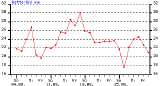 The Central England Temperature for August 2002 was 17.1°C, which is 0.8 degC above the mean for the standard reference period 1971-2000; in the last 100 years only 12 Augusts were warmer, two had the same mean temperature, and 86 were cooler. However, in the last 20 years the Augusts of 1983, 1984, 1990, 1991, 1995 and 1997 were all warmer. Daytime temperatures ranged from 1.5-2.0 degC above normal in parts of East Anglia the Midlands and southeast England, to 0.5 degC below normal on some northwest-facing coasts. Night-time temperatures were mainly between 1.0 and 2.0 degC above the normal.
The warmest days over England and Wales were the 15th and 17th, the temperature reaching 31°C at Hunstanton (Norfolk) and Herne Bay (Kent) on the latter date. A notable 'high' of 27.6°C was recorded at Strath of Orchy (Argyll) on the 1st. In southern England the warmth was so consistent that there were only three days with afternoon temperature below 21°C in the London area. The month's lowest temperature of minus 0.5°C was recorded in Strathardle (Perthshire) overnight 30th/31st.
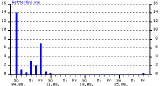 Rainfall, averaged over England and Wales, was 74mm which is 86 per cent of the average for the standard reference period 1971-2000 - rather lower than the figure for August 2001 but not as low as that for August 2000. During the last 100 years, 64 Augusts were wetter and 36 were drier. In the main population centres in Scotland the provisional monthly total for August 2002 was 98mm which is 125 per cent of the normal, while the Northern Ireland total was 49mm and this was the equivalent of just 62 per cent of the long-term average there.
Broadly speaking, it was wetter than average in eastern and central Scotland and in northern England, and much drier than average in the north and west of Scotland and also in many parts of the Midlands, east Anglia, southern England and south Wales, and Northern Ireland. Rainfall totals ranged from just 14mm at Pershore (Worcestershire) to 206mm at Fylingdales (North Yorks). Percentages ranged from 25 at Pershore to 254 at Southend (Essex) and 251 at Fylingdales.
There were a large number of heavy falls of rain during the first seven days. Fylingdales recorded 115mm and Leeming 91mm on the 1st, Hampstead in north London had 71mm on the 7th, and Milford Haven in Pembrokeshire 68mm on the 17th. Serious but short-lived flooding affected parts of Yorkshire, Lancashire, Durham and the Central Belt of Scotland during the first few days of the month.
Sunshine over England and Wales totalled 169 hours during August 2002, about 5 per cent below the long-term average for the month. The equivalent figure for Scotland's main population centres was 144 hours (4 per cent below), and for Northern Ireland 142 hours (9 per cent below). Monthly aggregates ranged from 87 hours at Kirkwall in Orkney to 245 hours at Shanklin on the Isle of Wight. Percentages ranged from 68 at Kirkwall to 116 at Barnstaple (Devon).
(c) Philip Eden
Get more monthly summaries here