Wind of the World
The Kosava
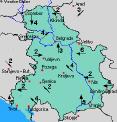 Location:, Serbia/Montenegro, Romania and Bulgaria.
The kosava (also: kossava, koschawa or koshava) is a cold, very squally ravine wind, descending from the east or southeast in the region of the Danube Iron Gate through the Carpathian Mountains, continuing westward over Belgrade, thence spreading northward to the Rumanian and Hungarian borderlands and southward as far as Nish. The name means 'coming from the Kosovo'. Kosava events are most prominent during the winter months, normally lasting two or three days, but can occur all year round.
 In winter it brings temperatures down to below 0°C and it is cool even in summer, when it is also dusty. A southerly wind is referred to as warm kosava and an east or southeast wind as a cold kosava.
This wind is caused by the interaction of synoptic scale circulation and the orography of the Carpathian Mountains. Most commonly it occurs with high pressure over eastern Europe (southern Russia) and low pressure in the western Mediterranean (or Adriatic Sea), a frequent situation in winter.
It is usually explained as a jet-effect wind through the Iron Gate, giving speeds well above the gradient wind, but it also has a katabatic component, somewhat intermediate between foehn and bora. The kosava has a marked diurnal variation, with its maximum occurring between 5am and 10 am.
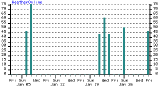 Gusts have been recorded in excess of 25-35 m/s over Belgrade and because of the depth of the atmospheric layer in which it occurs, up to 2000m, the kosava has the effect of cleaning the atmosphere very efficiently.