Weather Facts
The Future UK Climate
Over geological time there have been several periods when the Earth has experienced major drastic naturally climatic changes. However, much current resarch is devoted to an evaluation of changes brought about by human activity. But what effect will a rapid climate change have on the future UK climate? A group of British scientists from the Tyndall Centre for Climate Change Research at the University of East Anglia and the Hadley Centre for Climate Prediction and Research at the Met Office presented four possible climate change scenarios, using the latest global climate model from the Hadley Centre.
The resulting four scenarios are described by the emission scenarios on which they are based: Low Emissions, Medium-Low Emissions, Medium-High Emissions and High Emissions. The summarized key findings are:
 The UK climate will become warmer (Temperature)
By the 2080s, the average annual temperature in the UK may rise by between 2°C for the Low Emissions scenario and 3.5°C for the High Emissions scenario. There will be greater warming in the south and east rather than in the north and west, and there may be greater warming in summer and autumn than in winter and spring. By the 2080s for the High Emissions scenario, parts of the southeast may be up to 0.5°C warmer in summer. The temperature of UK coastal waters will also increase, although not as rapidly as over land.
High summer temperatures will become more frequent, whilst very cold winters will become increasingly rare. A very hot August, such as experienced in 1995 when temperatures over England and Wales averaged 3.4°C above normal, may occur one year in five by the 2050s for the Medium-High Emissions scenario, and as often as three years in five by the 2080s. Even for the Low Emissions scenario, by the 2080s about two summers in three may be as hot as, or hotter than, the exceptionally warm summer of 1995.
 Winters will become wetter and summers may become drier (Precipitation)
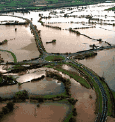
Winters will become wetter and summers may become drier throughout the UK The relative changes will be largest for the High Emissions scenario and in the south and east of the UK, where summer precipitation may decrease by 50% or more by the 2080s and winter precipitation may increase by up to 30%. Summer soil moisture by the 2080s may be reduced by 40% or more over large parts of England for the High Emissions scenario.
Snowfall amounts will decrease throughout the UK. The reductions in average snowfall over Scotland might be between 60% and 90% (depending on the region) by the 2080s for the High Emissions scenario.
Heavy winter precipitation will become more frequent By the 2080s, heavy winter precipitation intensities that are currently experienced around once every two years, may become b etween 5% (Low Emissions) and 20% (High Emissions) heavier.
Relative sea level will continue to rise (Sea Level Changes)
Relative sea level will continue to rise around most of the UK's shoreline. The rate of increase will depend on the natural vertical land movements in each region and on the scenario. By the 2080s, sea level may be between 2 cm below (Low Emissions) and 58 cm above (High Emissions) the current level in western Scotland, but between 26 cm and 86 cm above the current level in southeast England.
Extreme sea levels will be experienced more frequently. For some east coast locations, extreme sea levels could occur between 10 and 20 times more frequently by the 2080s than they do now, under the Medium-High Emissions scenario.
Reference:
Hulme, M., Turnpenny, J., Jenkins, G., (2002). Climate Change Scenarios for the United Kingdom: The UKCIP02 Briefing Report. Tyndall Centre for Climate Change Research, School of Environmental Sciences, University of East Anglia, Norwich, UK. 14pp
The full report can be downloaded from the UKCIP site.