Stormy Britain
Widespread damage
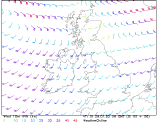 The violent storms in Britain left seven people dead, cut power lines to thousands of homes and caused widespread material and structural damage, police said Monday.
Five people were killed in road accidents -- two in western Scotland and three in northeastern England -- when strong winds flipped over their cars. Another Scottish man was killed when a tree crushed him, and a woman, aged about 40, died in the city of York in the north of England, when construction materials being used for the renovation of a church fell onto her.
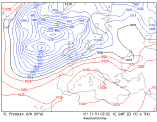 Winds of up to 190 kilometers (120 miles) an hour were reported from the summit of Britain's highest mountain, Ben Nevis, in the Scottish Highlands. The Beaufort wind scale classifies wind speed excxeeding 117 kph (74 mph) as force 12, equivalent to Hurricane wind speeds. However, yesterday many places in northern Britain exceeded those figures by far.
Authorities also feared flooding in some parts of Scotland, while in the north, more than 40,000 homes were without electricity. Officials said power cuts had also affected thousands of homes in central Scotland. The storms interrupted rail services to and from Glasgow, with many trains cancelled. The M6 was temporarily closed.
January has produced a number of significant storms during the last century, such as the big Norht Sea flood on 31 January and 1 February 1953, or the so called Glasgow hurricane of 15 January 1968.
The storm outlook for the rest of the week doesn't show much of a relief as violent southwesterly winds will continue to batter Britain until Sunday at least.