Winter Olympics
Salt Lake City Climate
 Olympic Climate from WeatherOnline
What will the weather be during the 2002 Winter Olympics and Paralympics? Colder and snowier winters in northern Utah usually occur when the jet stream is displaced to the south of its usual position while warmer and drier conditions prevail when the jet is displaced to the north. During the past 2 Olympic periods, February 2000 and 2001, the jet was weak and frequently splitting off with th result that both years were wetter than normal while temperatures were above normal in 2000 and near normal in 2001.
Utah weather is primarily influenced by the mountain ranges of the western United States. For example, the Sierras to the west wring moisture from, Pacific winter storms while the Rockies to the north and east inhibit Arctic air. In the vicinity of the Olympic venues, the Wasatch Mountains of northern Utah are a major barrier to storms crossing the Great Basin. As the air is forced to rise over the Wasatch, precipitation is enhanced. For example, during February, snowfall on average increases from roughly an inch (2.5 cm) over the western deserts to 11 inches (28 cm) in the Salt Lake Valley to over 75 inches (191 cm) near the top of the Wasatch; in the lee of the range, precipitation decreases to 21 inches (53 cm) at Park City. The Great Salt Lake helps to modify local wind circulations and lake-effect snow storms downwind of the lake are common (affecting the Ogden area when the winds are from the west and the Salt Lake Valley when the winds are from the northwest).
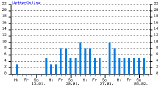 Typical February temperatures in the Olympic area will vary between below freezing -4C (25F) and about 5C (41F), and from -1C (30F) to above 10C (50F) in March. However, arctic air outbreaks may cause temperatures below -18C (0F), while record highs may reach 18C (65F) in february and 24C (75F) in March. The mountain valleys to the east are at higher elevation resulting in overall cooler and slightly snowier conditions.
Average snowfall varies from 28 cm (11 inches) to 41 cm (16 inches) carried by an average nimber of 5 snow storms in February. Snow storms are equally likely during March. Thick fog is not uncommon in the valleys, with roughly an 8% chance that fog develops on any particular day in Februar.
Check for current conditions here
Travel Planner for Salt Lake City