June Lookback
Scottish records tumble
By Philip Eden
The first half of the month was markedly cyclonic, but mean sea-level pressure was much higher during the second half with westerly winds prevalent. Both patterns brought frequent rain to western districts, but in eastern Britain it was largely dry during the second half of the month.
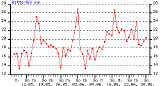 The Central England Temperature (CET) for June 2002 was 14.3°C, which is exactly equal to the mean for the standard reference period 1971-2000; in the last 100 years 49 Junes were warmer, five had the same mean temperature, and 46 were cooler (as measured by the CET). Daytime temperatures ranged from 1.5 degC below normal in western, central and southern Scotland, southwest Wales and Cornwall, to 2 degC above in Shetland and Orkney, and in Norfolk. Night-time temperatures were widely around 1 degC above normal, but 2.5 degC above in Shetland. It was the warmest June at Lerwick in Shetland since records began there in 1911.
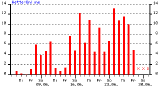 The warmest days over England and Wales were the 2nd and the 17th, the temperature reaching 29.3°C at Coltishall, near Norwich, on the latter date. The temperature in London exceeded 20°C daily from the 13th-26th inclusive. Notably high temperatures occurred on the 5th-8th in northwest Scotland with 27.6°C at Lochcarron in Wester Ross on the 6th. At the very same time it was extremely cool over England and Wales with an afternoon maximum of just 10.3°C at Loftus in North Yorkshire on the 5th. It was a frost-free month, the lowest air temperature of all being 0.1°C at Aboyne, Aberdeenshire, overnight 3rd/4th.
Rainfall (up to 10pm on the 30th), averaged over England and Wales, was 60mm which is 93 per cent of the average for the standard reference period 1971-2000 (rainfall on the night of the 30th may lift this figure by 2 or 3mm). It was not as dry as the Junes of 2001 and 2000 but it was drier than those of 1999, 1998 and 1997; during the last 100 years 54 Junes were wetter and 46 were drier. In the main population centres in Scotland the provisional monthly total for June 2002 was 95mm which is 156 per cent of the normal, while the Northern Ireland total was 89mm and this was the equivalent of 151 per cent of the long-term average there.
Broadly speaking, it was wetter than average in Cornwall and Devon, parts of London and the Southeast, Wales, northwest England, Northumberland, southern, central and western Scotland, and Northern Ireland. Dry regions were northeast Scotland, Yorkshire, Lincolnshire, the Midlands, East Anglia, the northern Home Counties, and Wessex. Rainfall totals ranged from 19mm at Coningsby (Lincs) to 201mm at Capel Curig (Snowdonia). Percentages ranged from 38 at Coningsby to 224 in Glasgow where it was the wettest June for at least 100 years.
There were few individual daily falls of note, but 39.2mm fell on the 9th at Lake Vyrnwy in mid-Wales and 37.8mm on the 5th at Kenley in Surrey. Rain fell on 28 out of the 30 days at several sites in the Hebrides and the western highlands.
Sunshine over England and Wales (including an estimated amount for the 30th) totalled 171 hours during June 2002, about 17 per cent below the long-term average for the month. The equivalent figure for Scotland's main population centres was 132 hours (29 per cent below), and for Northern Ireland 157 hours (17 per cent below). Monthly aggregates ranged from 89 hours at Broadford aerodrome on the Isle of Skye to 225 hours at Clacton in Essex. The totals of 99 hours at Glasgow and 101 hours at Edinburgh were both the lowest in these cities since 1966. Percentages ranged from 53 at Broadford and Glasgow to 133 at Fair Isle (between Orkney and Shetland) where it was the sunniest June for four years.
(c) Philip Eden