April Lookback
Another warm month
By Philip Eden
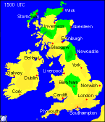 High pressure dominated until the 25th with southerly winds blowing more frequently than usual. The last six days were markedly cyclonic.
The Central England Temperature for April 2002 was 9.4°C which was 1.3 degC above the mean for the standard reference period 1971-2000. Daytime temperatures were between 1.5 and 2.5 degC above average, while nighttime values were less than 1 degC above. In the last 100 years only 11 Aprils were warmer as measured by overall mean temperature, including 1999, 1993 and 1987. But the mean maximum temperature was the highest since 1987. Frosty nights were frequent between the 4th and the 20th, and the lowest overnight reading to hand was -7.2°C at Altnaharra in Sutherland on the night of 12th/13th. There were notable warm spells from the 3rd to the 5th, and from the 21st to the 24th. In Central London the mercury reached 22.5°C on the 3rd, 23.5°C on the 23rd (the highest anywhere in the UK in April since 1996) and 23.1°C on the 24th.
Rainfall, averaged over England and Wales, was 51mm which is 11% below the average for the standard reference period 1971-2000. Thus it was the driest April since 1997, and during the last 100 years 64 Aprils were wetter and 36 were drier. In the main population centres in Scotland the provisional monthly total for April 2002 was 46mm which is 1% above normal, while the Northern Ireland total was 84mm and this was 70% above the long-term average there. Much of eastern, central and southern Britain had little or no rain until the morning of the 25th, and isolated sites in Lincolnshire and the East Riding of Yorkshire recorded less than 1mm of rain between March 21 and April 24 inclusive. The last six days, however, were generally very wet with over 150mm locally in Snowdonia and western Scotland. Totals for the month ranged from 234mm at Nantmor in Snowdonia to just 14mm at L'Ancresse on Guernsey.
Sunshine over England and Wales totalled 196 hours during April 2002, about 27% above the long-term average for the month. The equivalent figure for Scotland's main population centres was 139 hours (10% below), and for Northern Ireland 164 hours (just 1% above). Monthly aggregates ranged from 113 hours at Bishopton near Glasgow to 260 hours at Herne Bay in Kent and over a large part of East Anglia and Southeast England the excess over the long-term average amounted to 50-60 per cent.
(c) Philip Eden