January 2005 Lookback
Warmest since 1990
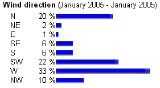
There were two controlling factors which determined January’s weather: persistent westerly winds, and high pressure anchored to the south or southwest of the UK. The westerlies brought an almost uninterrupted supply of Atlantic air across the country making it very wet in northern and western regions and also one of the mildest Januarys on record, while the remarkably persistent high pressure system ensured that southern, central and eastern England had a very dry month.
The average afternoon maximum temperature ranged from 10.8C at Torquay in Devon to 5.5C at Dalwhinnie in Inverness-shire, while average overnight minimum varied between 8.4C at St Mary’s in the Isles of Scilly and –0.3C at Braemar in Aberdeenshire. The Central England Temperature, which takes into account both daytime and night-time temperatures, stood at 6.1C which is 1.9 degC above normal, making this the warmest January since 1990. There have been only six warmer in the last 100 years.
 There were several exceptionally mild days when the temperature exceeded 14C with a highest reading of 14.7C at Church Fenton, near York, on the 9th. The following night was abnormally warm, and at Weybourne on the north Norfolk coast the temperature remained above 12.7C throughout, making this the warmest January night anywhere in the UK for 47 years. The month’s lowest temperature was –9.2C at Dalwhinnie overnight 22nd/23rd, but several sites around the coastline of Wales and southern England reported an entirely frost-free January.
Rainfall, averaged over England and Wales, totalled 56mm, 40 per cent below the long-term average. There have been twenty drier Januarys in the last 100 years, most recently in 2000. The equivalent figures for Scotland were 146mm and 45 per cent above, and for Northern Ireland 89mm and three per cent below. The western highlands, the Lake District and Snowdonia collected more than twice their normal amount of rain, and a prolonged downpour between the 6th and 8th led to serious flooding, notably at Carlisle.
Sunshine duration in England and Wales averaged 63 hours, some 15 per cent above normal, but January was sunnier than this in 2003, 2001 and 2000. In Scotland the monthly total was 38 hours and in Northern Ireland 43 hours, both 15 per cent below normal. Sunniest place was Herne Bay, Kent, with a remarkable total of 99 hours.
© 2005 Philip Eden