January Lookback
Warmest since 1993
By Philip Eden
 High pressure persisted for most of the first week, and it remained over the near-continent until mid-month. The second half of January was dominated by a very disturbed southwesterly airflow with Atlantic depressions and fronts crossing the country at frequent intervals.
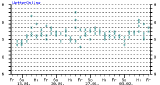
The Central England Temperature (CET) for January 2002 was 5.7°C which was 1.8 degC above the mean for the standard reference period 1971-2000. In the last 100 years there were 12 warmer Januarys (seven of them since 1974), while 88 were colder. The first half of the month was 0.8 degC colder than average whereas the second half was 4.4 degC warmer than average - the warmest since 1921. There were some notably cold nights during the first week, including -11.9°C at Sennybridge (Powys) on the 1st, -13.6°C at Glenlivet (Moray) on the 2nd, and -10.3°C at Perth on the 3rd. Frost was rare after the 10th. Mild days were frequent, and maxima of 14&derg;C or more were recorded somewhere or other in the UK on eight days with 15.0°C at Worcester on the 27th.
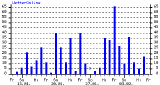 Rainfall, averaged over England and Wales, was 85mm which is 96% of the average for the standard reference period 1971-2000. During the last 100 years, 51 Januarys were wetter and 49 Januarys were drier. In the main population centres in Scotland the provisional monthly total for January 2002 was 106mm which is 145% of the normal, while the Northern Ireland total of 79mm amounted to 101% of the long-term average there. The dominant southwesterly winds meant that west-facing slopes were very wet, while east-coast lowlands were very dry. At Capel Curig in Snowdonia 428mm of rain fell during January (most of it after the 13th) compared with just 26mm at Newcastle-on-Tyne. Many places were snow-covered until the 5th, although no snow fell during the month over most of England and Wales. Snow returned briefly to Scotland on the 25th. Freezing drizzle led to glazed frost in Wales, the Midlands and eastern England on the evening of the 4th.
Strong winds were infrequent during the first half of January, but gales swept Ireland and Scotland on several days after mid-month. A destructive gale on the 28th led to seven deaths; the highest gusts at low-level stations included 99mph at Malin Head in the Irish Republic and 82mph at Edinburgh Airport - such a gale can be expected to occur in Scotland with a return period of about one year.
Sunshine over England and Wales totalled 47.7 hours, about 10% below the long-term average, making it the dullest January since 1996. Roughly half the month's sunshine occurred during the first four days, so the lack of sunshine thereafter was exceptional. The equivalent figure for Scotland's population centres was 42.6 hours (13% below), and for Northern Ireland 51.5 hours (1% above). Monthly aggregates ranged from 22 hours at Lerwick in Shetland to 87 hours at Herne Bay in Kent.