January Lookback
A sting in its tail
 By Philip Eden
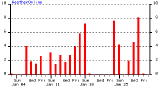
Snowstorms, thunder, lightning, hail, hard frosts, sparkling sunshine, damaging gales, and finally buckets of rain: the gods delivered a month�s worth of weather to most parts of the UK during the last four days of January.
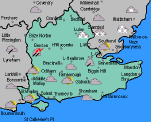 The combination of heavy snow, thunder and lightning which visited much of Britain on Wednesday 28th is very rare in inland regions though much commoner along Atlantic and North Sea coasts. The development of thunderstorms requires a strong contrast between warm air in the lower atmosphere and cold air aloft. This is easy to achieve in summer when the strength of the sun is greatest, but in winter the sun is relatively feeble and the contrast can only be generated when surface air from the relatively warm Atlantic is overlain by exceptionally cold air of Arctic origin in the upper atmosphere. Snow lay 13cm deep in south Lincolnshire and north Cambridgeshire early on the 28th, and 22cm deep at Glenlivet in Moray the following morning.
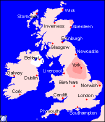 January itself provided a wide variety of weather, although there was probably too much of the dull, wet and windy stuff for most people�s tastes. Monthly temperatures were between 1.0 and 1.5 degC above the average for the standard reference period 1971-2000 in all parts of the country. The Central England Temperature of 5.3�C was 1.1 degC above normal and in the last 100 years there were only 20 warmer Januarys, two with the same mean temperature, leaving 78 that were colder. The warmest day was the 22nd when the mercury climbed to 14�C at Colwyn Bay in north Wales, while the coldest night was the 30th/31st when the temperature plummeted to �10�C at Altnaharra and Kinbrace, both in Sutherland.
Although it was a fairly wet month in most places, the second half was generally drier than the first half, although heavy rains returned on the 31st, boosting monthly totals sufficiently to place January in the very wet category. Averaged over England and Wales the monthly total of 121.8mm was exactly 30 per cent above the norm and there were 22 wetter Januarys in the last 100 years; the monthly rainfall total for Scotland�s main population centres of 111.5mm was 43 per cent above, and Northern Ireland�s 111.0mm was 22 per cent above. Highest monthly totals were 368mm at Capel Curig in Snowdonia and 353mm at Strath of Orchy in Argyll, while at the other extreme Shoeburyness in Essex collected only 46mm and nearby Clacton just 51mm. Percentages of the long-term average ranged from 222 at Carter Bar in Roxburghshire to 68 at Aboyne in Aberdeenshire.
There was a shortage of sunshine during the first half of January, but the second half fared much better and the monthly total of 55.1 hours in England and Wales was 3 per cent above the average. Scotland and Northern Ireland, though, both reported a deficit of 16 per cent. The biggest sunshine total was 83.6 hours at Shanklin on the Isle of Wight while the smallest was 16.9 hours at Aviemore in Inverness-shire. Percentages ranged from 166 at Lerwick in Shetland to 42 at Aviemore. On the 29th Eastbourne reported 8.9 hours of bright sunshine � a new daily record for January in the UK.
(c) Philip Eden