July is getting drier
2002 bucks the trend
 By Philip Eden
All the talk of man-made climate change during recent years obscures the fact that our climate is always changing in response to a large number of natural influences - ranging from variations in the tilt of the Earth on its axis to the contrasting concentrations of salts in different parts of the oceans. One of the most remarkable changes in the British climate during the last two centuries - one that might surprise many - is the drying out of July.
We have national rainfall records in the UK back to 1766, and more limited data since 1697. These show a progressive downward trend in July rainfall during the last 200 years. The mean July rainfall for the first decade of the 19th century, averaged over England and Wales, was 91.2mm, compared with just 55.1mm for the 1990s, a drop of 40 per cent. To emphasise the point, July was the wettest month of the year for several decades during the early 19th century, but it had become the driest month of the year by the end of the 20th century.
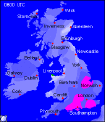 Last week's downpours remind us that, despite the long-term trend, July can still deliver copious amounts of rain. Tuesday July 9 was a particularly wet day over eastern, central and southern parts of the UK, with over 25mm falling in Devon, Dorset, Wiltshire and Hampshire. In southern Lincolnshire there had been a heavy downpour on Monday the 8th as well, and 48-hour totals here included 39mm at Holbeach and 35mm at Skegness. Fortunately, the deluge predicted for southern England on Friday the 12th failed to materialise, otherwise serious flooding would probably have ensued.
After barely two weeks, large parts of England - much of London and the Southeast, Wiltshire and Hampshire, Lincolnshire and Leicestershire - have already collected more than the normal amount of rain for the entire month of July. On the Isle of Wight there was almost two months' worth of rain between July 1 and 12. With just a few additional showers during the next two weeks it will be the wettest July since 1993, and if the rate of rainfall experienced during the first of the month continues throughout the second half it could yet equal the exceptionally wet July of 1988. The complaints about the weather during that month were certainly justified. Rain fell on 23 or 24 days over much of the UK, and on all 31 days in western and southern Scotland, Cumbria and Snowdonia. Yet who remembers July 1988 now?
(c) Philip Eden
