Spring has sprung
Warm thoughts of March
The flirtation with spring that most of us are presently enjoying is not that unusual, but it is no less welcome for that.
At the time of writing (the morning of the 18th) we have not yet hit the 20 degree mark, with highest readings under standard conditions being 19.1șC at Northolt in northwest London on the 16th, and 19.2șC at St James’s Park in central London on the 17th. Slightly higher figures were reported from the London Weather Centre, but that is a rooftop site and therefore not standard, and from Gravesend/Broadness in Kent where the site characteristics also favour unrealistically high temperatures during spells of warm weather.
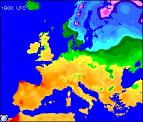 There have been some exceptionally warm nights as well. The temperature fell no lower than 12.8șC at Ballykelly in County Londonderry overnight 15th-16th, and this is within a degree of the all-time UK record for March.
This particular warm spell has depended on strong winds importing air from tropical latitudes as is the case during episodes of unseasonably warm weather during the winter. Not all early-spring “heatwavesö are caused this way. Probably the majority of them are associated with winds which are very light or non-existent, and on these occasions the warmth is largely determined by the strength of the sun. It just goes to show how powerful the sun can be even before the spring equinox.
A search through the records shows that the temperature has climbed to at least 21șC (70șF) somewhere or other in the UK in March in 15 out of the last 100 years – in other words, roughly one year in seven on average. Maxima of 22șC or more were logged in nine Marches during the 20th century century, 23șC was exceeded on four occasions, and 24șC twice. The warmest March day of all was the 29th in 1968 when the temperature touched 25.0șC at Santon Downham and Cromer, both in Norfolk.
High temperatures so early in the season are not confined to southern England as might be expected. The earliest date for 21șC to be reached was the 8th in 1929 at Colwyn Bay in north Wales, and the following day 22.2șC was recorded at Keswick in Cumbria. On March 12, 1957 the temperature peaked at 23.3șC at Haydon Bridge in Northumberland, 22.2șC at Elgin and Gordon Castle (both in Morayshire), and even 20.6șC at Cape Wrath - the northwestern-most tip of the Scottish mainland.
In the Irish Republic, the highest March temperature of 23.6șC was recorded at Trinity College, Dublin, on March 28, 1965. On the same date the mercury climbed to 21.7șC at Armagh in Northern Ireland.
©Philip Eden