Christmas weather
Rarely white
With the forecast for the Christmas holiday becoming clear, it looks as though most parts of the UK will have a spell of quiet, fine, rather cold weather with frost at night, and bright periods by day. Showers should be confined to eastern coastal districts, and these showers could well fall as snow in eastern Scotland and northeast England.
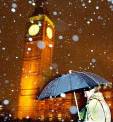 Truly white Christmases – that is, with a substantial covering of snow over a large swath of the UK – have occurred during the last hundred years only in 1981, 1970, 1968, 1956, 1938, 1927 and 1906. Several recent years, including 2004, have produced a smattering of snow, and special mention must also be made of 1995 when a ferocious Christmas Day blizzard swept northern Scotland and the coastal fringe of northeast England. Deep snow, though, is one of the rarer presents that Mother Nature packs into the national Christmas stocking.
Since the Clear Air Acts of the 1950s, widespread fog has been an infrequent visitor over the holiday. Foggy Christmas Days happened in 1992, 1973 and 1969. Before that, there was a notable run of three Christmases from 1942 to 1944 which were persistently foggy on from Christmas Eve until Boxing Day.
Arguably the most unusual type of Christmas weather is the thunderstorm. In London it has thundered on Christmas Day only in 1990, 1989 and 1947 in the last 140 years, and on Boxing Day only in 1959. Four occasions out of 280 suggests odds of 70:1. The two consecutive thundery Christmases of 1989 and 1990 provide a classic example of why you cannot use this sort of statistical information to make any useful sort of weather prediction.
The 1990 storms were associated with a vigorous cold front which swept rapidly eastwards across the entire British Isles, giving us all a day of really wild, windswept weather with heavy rain and hail. There were also a number of short-lived tornadoes reported from southern and midland counties of England, notably Somerset and Wiltshire.
© Philip Eden