A winter drought
Damp bur dry
A winter drought sneaks almost unseen through the January landscape. Gardens are dank, trees drip, parks and playing fields are muddy, roads and footpaths are moist � not through excessive rainfall but because the trivial quantities of drizzle and condensation fail to evaporate in the damp winter air. But anyone who lives near a river or stream in southern, eastern and central England knows that we are indeed in the midst of a notable drought. Over large parts of the country water levels are now lower than their mid-summer norm.
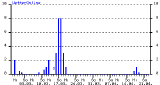 With less than a week of January remaining, and no significant rain likely during the coming days, this month will almost certainly be one of the five driest Januarys over England and Wales in the last 100 years. So far this month, averaged nationally, the rainfall stands at 29mm, which compares with the long-term January average of 94mm.
Small areas of northern and western Scotland have recorded slightly more rain than usual, whereas the shortfall has been greatest in those areas most in need � Southeast England, the Midlands, East Anglia, Lincolnshire and parts of Yorkshire. At Norwich, for instance, only 7mm of rain has fallen so far this month, barely one-eighth of the normal amount there. Aggregates of less than 10mm have been reported from places as widely scattered as Kinloss in northeast Scotland, Hereford and Cambridge.
Over most of the UK, 2005 was not as dry as 2003, but this was not true in a relatively small zone of southern England stretching from Salisbury in the west to Maidstone in the east, and from Oxford in the north to the Isle of Wight in the south. In this area it was generally the driest year since 1973, and at one or two locations in the Oxford/Reading/Basingstoke area since either 1947 or 1921.
Winter rainfall is important. It fills the reservoirs and replenishes the water-bearing rocks beneath us. During the late spring and summer most of the rainfall is used up by growing plants or it simply evaporates, so the next two to three months are crucial if we are recover from the present situation. Unless February and March are very wet indeed, some parts of southern England are in for a summer of serious water shortage.
© Philip Eden
Read more from Philip about agricultural drought