Bizarre showers
Frogs and fishes
By Philip Eden
The very disturbed weather last week brought a concoction of rain, snow, hail and thunder, and there were even a few reports of funnel clouds. These are embryonic tornadoes, although the twisting funnel does not quite reach the ground. This is the sort of weather when more exotic items occasionally come down with the rain and hail.
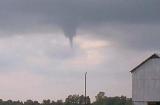 The strong updraughts associated with cumulonimbus clouds can carry all sorts of debris high into the sky before finally releasing it as a downdraught develops. For example, a small tornado passing over a lake will not only suck water into its circulation, but also weed, frogspawn, fish, and even gravel.
The Tornado and Storm Research Organisation, usually known as TORRO, has studied and catalogued such events, so most of the best descriptions come from Britain. One of the earliest references was found in the Athenaeum magazine. It described a fall of small fish and frogs early in July 1841 in Derby. In March 1859, a letter to a local newspaper the vicar of Aberdare in Glamorgan also described a shower of fish - mainly sticklebacks and minnows. Probably the earliest such account was given by the Roman writer Pliny in his Natural History written during the first century AD.
TORRO has also noted, among others, a shower of hazelnuts in Bristol on March 13 1977, a fall of grass and hay in Poole, Dorset, on August 9 1977, and one of tiny frogs at Canet-Plage, near Perpignan, in the south of France on the 28th of the same month. Maggots fell on Acapulco, Mexico, during a storm in October 1968.
Odder still were the events of January 3 1978, when a vigorous cold front swept eastwards across England. As the front reached East Anglia a powerful squall line developed and several short-lived tornadoes were seen. It appears that a flock of pink-footed geese were picked up by one or more of these tornadoes from The Wash; subsequently 136 dead geese fell from the sky along a track 28 miles long, running from west to east across Norfolk.
Several authenticated falls of coal were reported from the Bournemouth and Poole districts during violent storms on June 5 1983. It is believed that a small tornado may have picked up debris from a merchant's yard. And on the same day a crab encased in a thin layer of ice fell among large hailstones further along the Channel coast near Brighton. Much earlier, on April 29 1868, a barrage of small stones fell during a ferocious thunderstorm in Birmingham, according to the local press at the time. The stones, mostly gravel-sized, was later analysed by geologists who pronounced them to be chips of Rowley ragstone, probably picked up by a severe squall or tornado in the vicinity of Rowley Regis in the Black Country.
Less strange but more worrying are the rare falls of isolated blocks of ice. These are not normally associated with storms or tornadoes, and in most cases are the product of leaky waste-disposal systems on overflying aircraft.
(c) Philip Eden