March Lookback
Another warm month
By Philip Eden
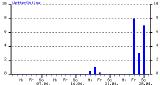 The pattern of consistently above average temperature which had prevailed over much of the UK since the second week of the year continued throughout most of March. The monthly statistics show that March was another warmer than average one, without being quite as abnormal as February had been. The mean monthly temperature for March ranged from about 0.5 degC above normal in northern Scotland to 2.5 degC above in the Midlands and East Anglia. The provisional Central England Temperature of 7.4C was 1.7 degC above the average for the standard reference period 1961-90. There have been only fourteen warmer Marches in the last 100 years, although eight of these have happened since 1989. The recent sharp upward trend in March temperature is highlighted by the fact that in the last fifteen years only two Marches, 1996 and 2001, were below the 1961-90 average, and those only by a fraction of a degree.
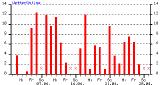 Rainfall last month varied widely, with southwest Scotland collecting almost double its usual amount while much of East Anglia received barely half its quota. Monthly totals ranged from 268mm at Strath Orchy in Argyll to 18mm at Shoeburyness in Essex, and most of that fell between the 10th and 20th with long dry periods fore and aft. Averaged over England and Wales the total rainfall of 53.8mm was 20 per cent below the long-term mean; in Scotland the equivalent figures were 126.5mm and 20 per cent above, and in Northern Ireland 53.0mm and 10 per cent below.
There was a general paucity of sunshine during the first three weeks of March, but the very sunny last week restored the balance in most areas. Averaged geographically, England and Wales had 3 per cent more sunshine than normal, Scotland had an excess of 10 per cent, and Northern Ireland an excess of 13 per cent. Eastern Scotland and eastern England were particularly sunny, and the total at Hunstanton in Norfolk of 157 hours was 36 per cent above the local average. Southwest England, however, reported a 20-25 per cent shortfall, and the total of just 86 hours at Culdrose in Cornwall was as much as 31 per cent below.
(c) Philip Eden