Global Temperatures 2002
Second Warmest Ever
Global temperatures in 2002 are likely to be 0.57°C (1.03°F)* above the long-term (1880-2001) average, which will place 2002 as the second warmest year on record. The only warmer year was 1998 in which a strong El Ni�o contributed to higher global temperatures.
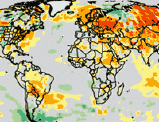 Land temperatures are likely to be 0.92°C (1.66°F)* above average and ocean temperatures 0.42°C (0.76°F)* above the 1880-2001 mean. Both land and ocean temperature will very likely rank as second warmest on record.
*All data in this report are preliminary and based on estimated December values. A full report will be available in January 2003.
Neutral ENSO conditions at the beginning of 2002 gave way to a strengthening El Ni�o episode during late boreal summer and continuing into early winter. Moderate positive anomalies of equatorial Pacific sea surface temperatures ( El Ni�o conditions) are expected to persist through the early part of 2003.
The Northern Hemisphere temperature will very likely average near record levels in 2002 at 0.66°C (1.19°F) above the long-term average. The Southern Hemisphere also reflected the globally warmer conditions, with a positive anomaly expected near 0.46°C (0.83°F).
During the past century, global surface temperatures have increased at a rate near 0.6°C/century (1.1°F/century), but this trend has dramatically increased to a rate approaching 2.0°C/century (3.6°F/century) during the past 25 years. There have been two sustained periods of warming, one beginning around 1910 and ending around 1945, and the most recent beginning about 1976. Temperatures during the latter period of warming have increased at a rate comparable to the rates of warming projected to occur during the next century with continued increases of anthropogenic greenhouse gases.
Read more about regional temperature patterns here
2002 - too wet or too dry? Read more about global precipitation patterns here.
Source: National Climatic Data Center / NOAA, all data and graphs copyright NCDC